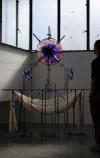
In Cultu Sancto
In cultu sancto grew out of a fascination with communities that organise themselves around the preservation of human remains. During a stay at the Bio-Engineering and Morphogenesis Lab of Adrian Ranga (KU Leuven), where neural organoids are grown from human tissue (small laboratory-made structures that mimic the early development of the brain), it became striking how ritualistic certain lab procedures are. The lab turned out to be a community in its own right, echoing another: the community around relics, fragments of the bodies of saints.
Both share charged gestures, garments, and thresholds: ethanol sprayed onto gloves, holy water at the church door, a fear of impurity that orders everything. The greatest difference lies in the status of those involved. Saints are venerated by name, while the people behind the cell lines from which these organoids grow remain anonymous, their material cultured and traded without a face.
This altar is a reliquary for the unknown saints of science: aluminium profiles, images of the lab’s research, a textile hanging dyed with the culture medium, and neon tubes arranged in a star, echoing the pattern of the vessels in which these organoids are grown.
The title is not my invention, it is just Latin. Cultus is the care you give to a thing. You cultivate a field, you culture cells, you give a saint his due. The same verb, colere, produced both culture and cult.
In cultu sancto was produced within the Organoid Intelligence residency run by Gluon with the Bio-Engineering and Morphogenesis Lab at KU Leuven, and shown in Shifting Worlds, the exhibition of FTI Brussels at Wiels, from 16 to 20 October 2026.